
Ephemera’s Epilogue
This series of usable art became part of a project for my graduate degree at Johns Hopkins University. The video to the left is a presentation about the origins and bones of Ephemera’s Epilogue. Below is a showcase of a few of the pieces.
Additionally you’ll find an interview with one of my advisors from Hopkins, Dr. Tristan Cabello, for the annual MLA colloquium. Let this be an inspiration to create your own ephemeral art!
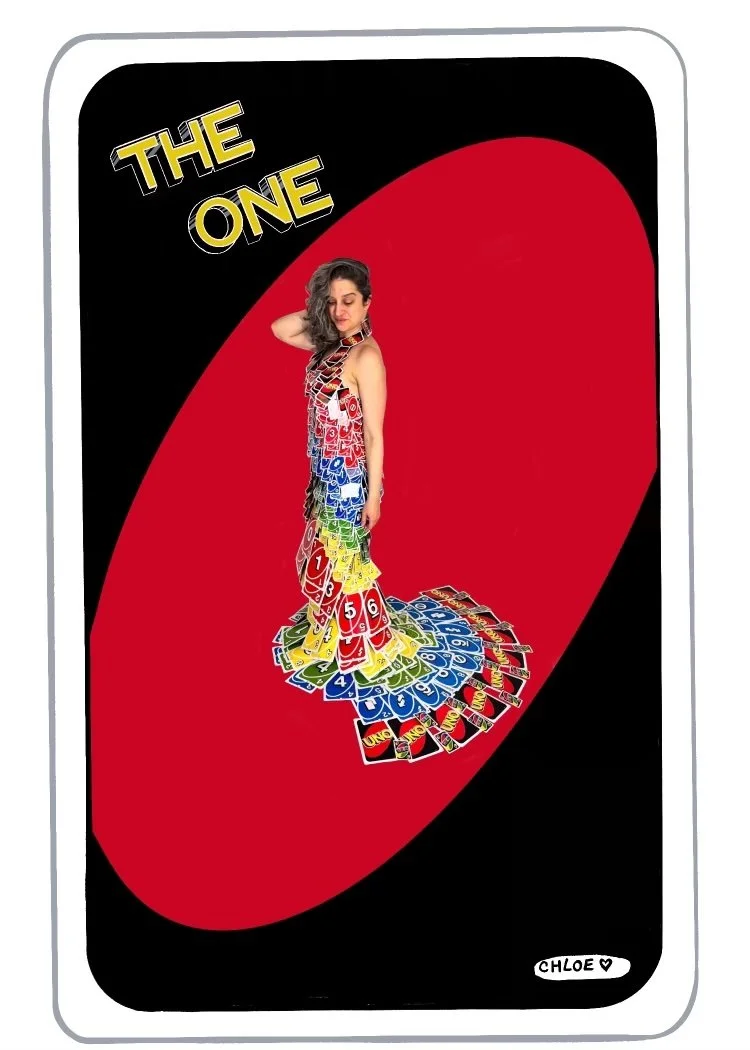
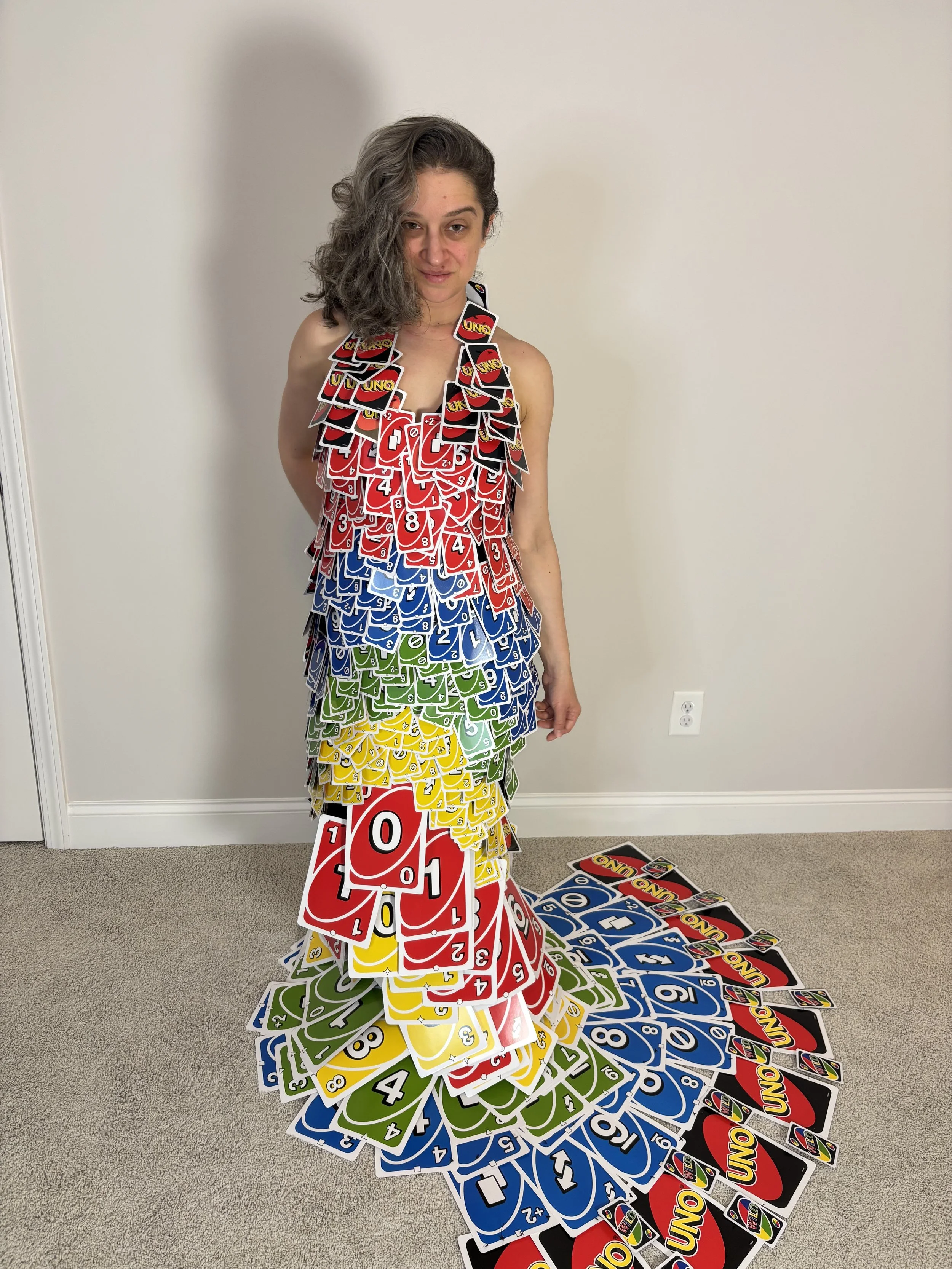
The One
Uno card decks, stretch mermaid gown base, tag gun stitches, 2026
Made from regular sized and jumbo sized Uno cards, The One is a ready-to-wear and one of a kind gown. Inspired by my collection of childhood games, many of which I kept for much of my adult life, this fancy frock reminds us that if you play your cards right you can find new kinds of beauty in tried and true classics.
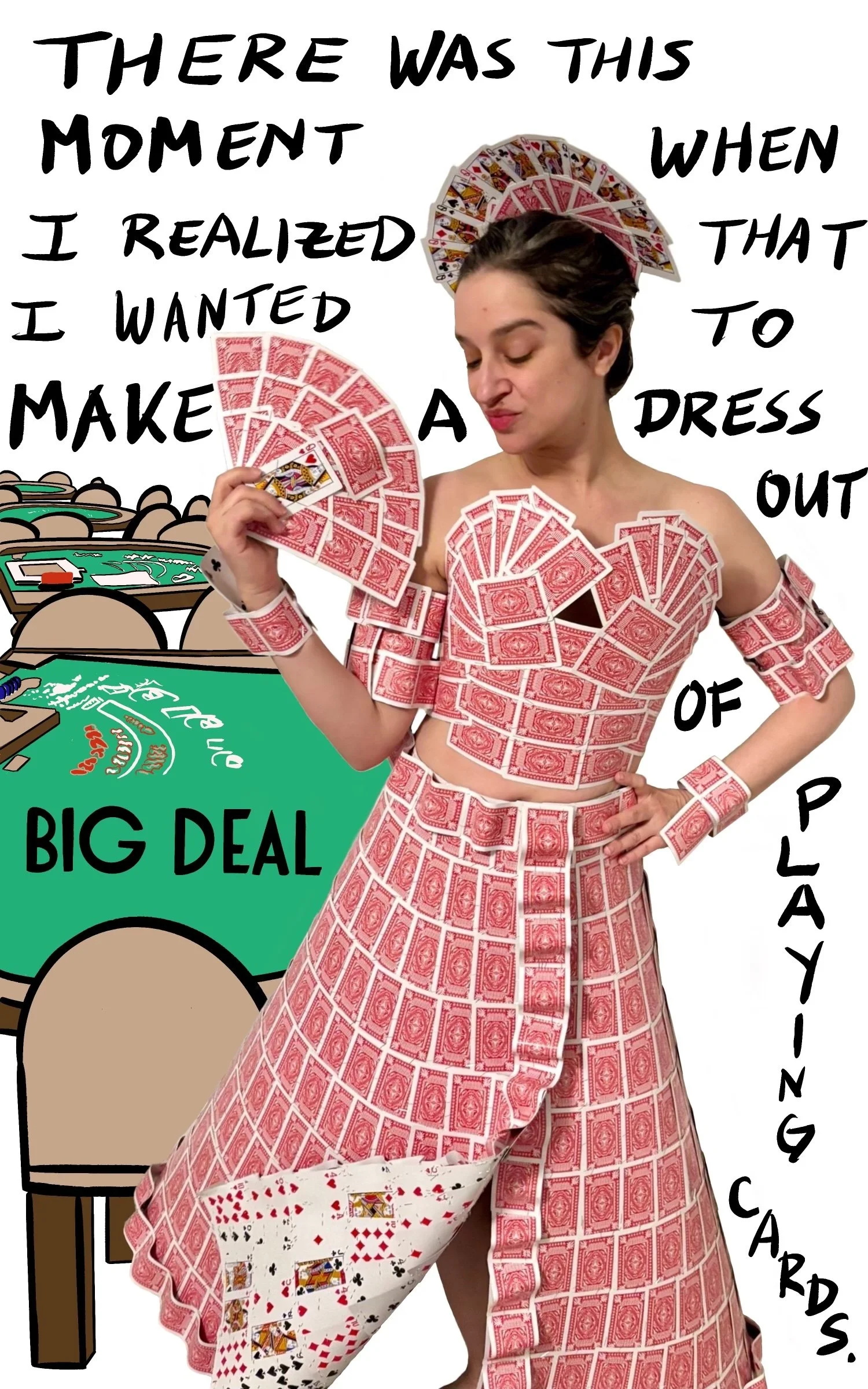
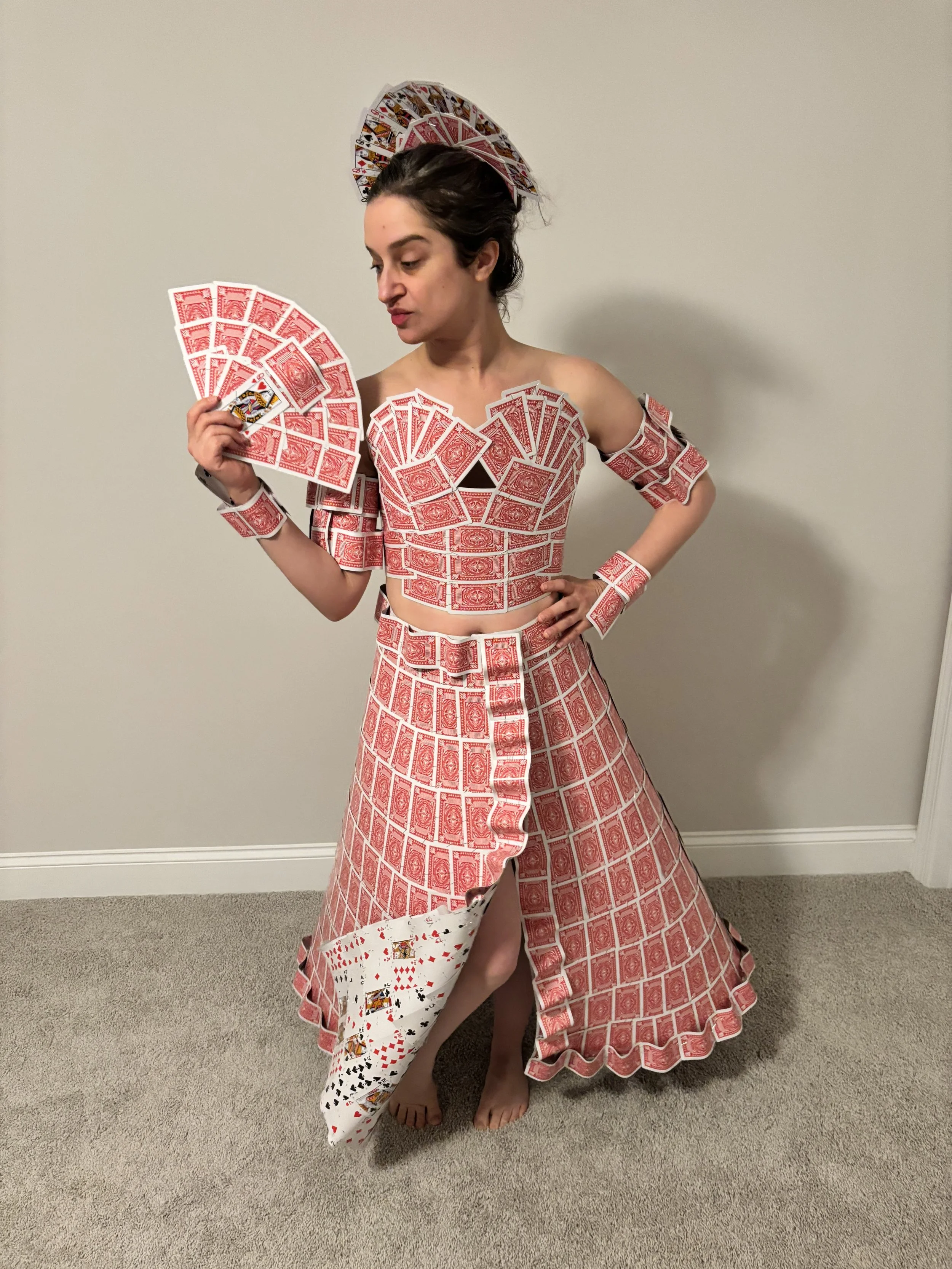
Big Deal
Playing cards, velcro with adhesive, staples, bobby pins, 2025
How many cards does it take to make the big, red, big deal? If you can guess you’ll win your very own deck of cards…In a fit of creativity on new year’s eve (2025-2026) I decided to get all dressed up with nowhere to go. It was one of my favorite holiday celebrations to date, a simple date with my imagination, culminating in Big Deal.
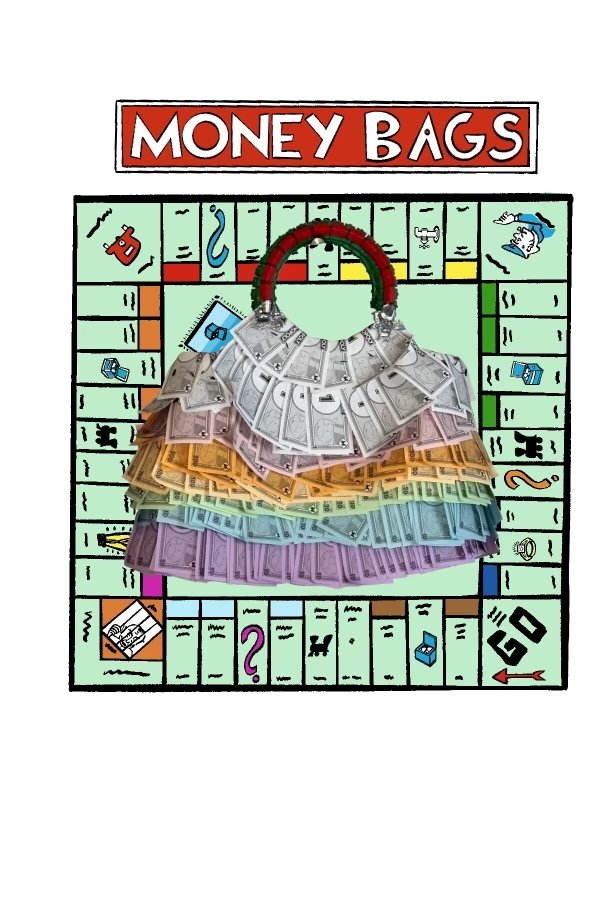
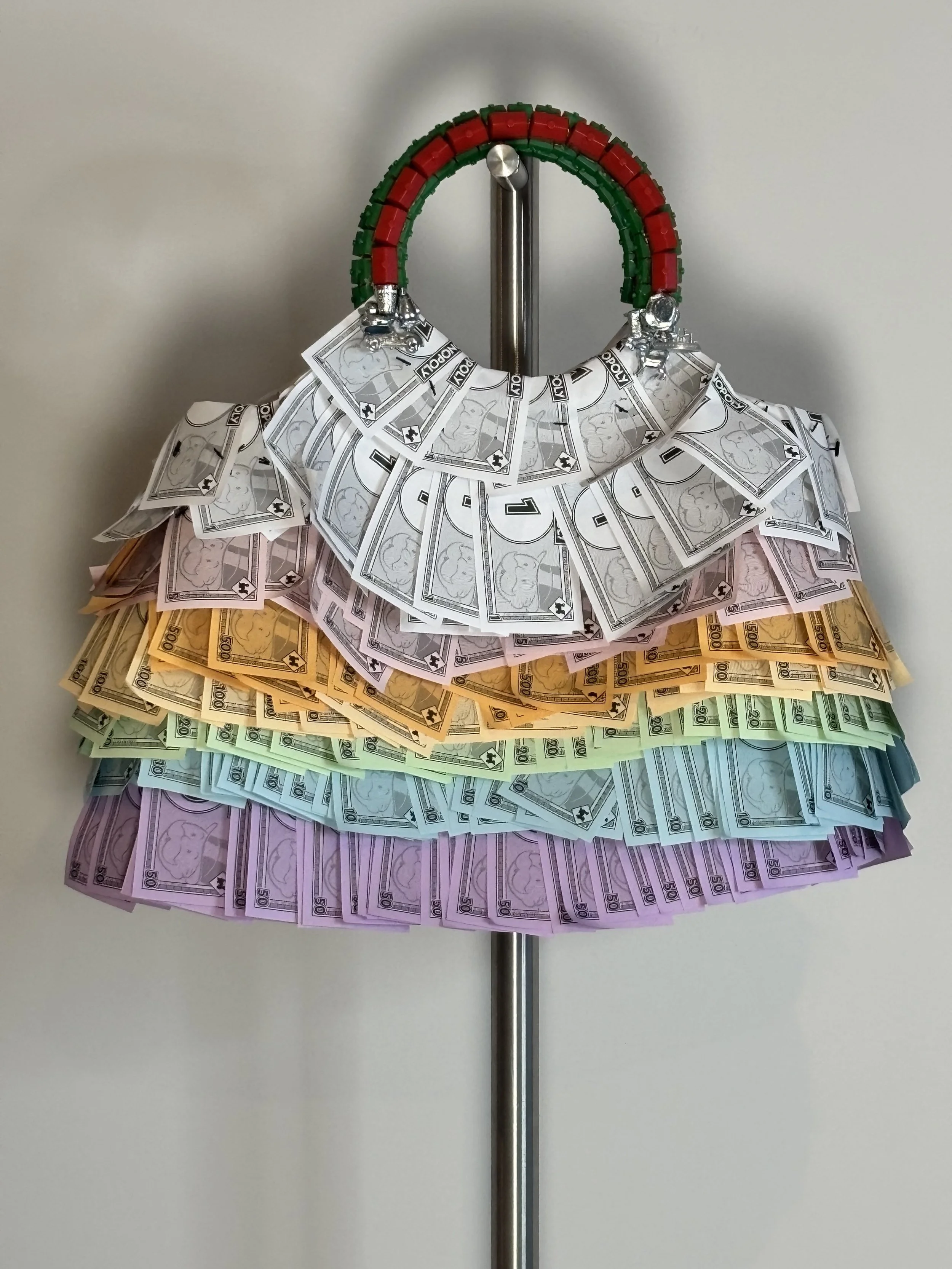
Money Bags
Monopoly money, Monopoly houses and hotels, Monopoly game pieces, cotton purse with plastic handles base, tag gun stitches, glue, 2026
Monopoly money at its finest, this wearable purse is covered in the classic currency. With hotel and house handles, and game piece embellishments, this showstopper accessory will wow at any gala or game night.
Johns Hopkins University MLA Program Critical Utopias: Liberal Arts in an Age of Uncertainty
Tristan Cabello: What drew you to this research topic?
Chloe Dolandis: I have always loved fashion and design. When I first began learning about sustainability as a child, I enjoyed incorporating reused and recycled objects into my arts-and-crafts projects. Because I now work peripherally in advertising, as a full-time voice actor who has recorded many commercials throughout my career, I am highly aware of some of the “behind the scenes” dynamics of both advertising and marketing. Creating my zine, Ephemera’s Epilogue, felt like an exhale because it challenged American consumerism, which sits at the center of marketing and advertising culture. I genuinely love my work, but I can also recognize aspects of the industry that I wish were different. Examining the consumption of ephemeral goods, many of which are quickly discarded after a single use, gave me a new appreciation for the objects we often take for granted.
Tristan Cabello: What was the most surprising or challenging part of your project?
Chloe Dolandis: Building the dresses was the most challenging part of the project. Conceptualizing some of the pieces over the course of several years was one thing, but figuring out their construction and physically assembling them was another challenge entirely. I was initially intimidated because I did not have an extensive background in sewing or clothing design. However, once I realized I could work with alternative materials and unconventional methods, such as using a tag gun to attach guitar picks to the base of a skirt, the process became incredibly fun. The unexpected became exciting. I also appreciated learning to let go of perfectionism. My goal was to create wearable pieces, not garments with flawless or perfectly symmetrical seams.
Tristan Cabello: How does your work connect to larger contemporary or historical questions?
Chloe Dolandis: Fast fashion has been criticized for many years, and some of the dresses featured in my zine stand in direct opposition to mass-produced clothing, particularly because certain pieces took more than twenty years to complete. At the same time, some of the works included in the zine are made from new materials, which also reflects my own participation in consumer culture. Ultimately, we all make choices about how we spend our time and money, and those choices are not always fully sustainable or ethically produced, concepts that are themselves difficult to define universally. Still, I believe that making a conscious effort toward more thoughtful and responsible consumerism remains important.
Tristan Cabello: What course, reading, or conversation in the MLA program most influenced this project?
Chloe Dolandis:Ephemera’s Epilogue began as my final project for Going Underground: Subculture and Social Justice in Self-Publishing, one of Ashley Acosta-Fox’s graduate courses. Knowing that I would have the opportunity to create a self-published zine centered on questions of social justice motivated me to finally complete many of the pieces I had long wanted to include. This course became one of the most memorable parts of my MLA experience because it offered us genuine creative freedom. An unexpected outcome of the experience was that it fundamentally changed how I think about higher education itself. It made me an even stronger advocate for approaches that move beyond standardized models of learning and creativity.
Tristan Cabello: What advice would you give future MLA students preparing a major research project?
Chloe Dolandis: Take your time and prepare carefully. Part of the reason I was able to include so much detail in Ephemera’s Epilogue is because I began thinking about the project years before its completion and paced myself once I knew the final deadline. With even more time, I probably would have included additional artworks. I would also encourage students not to be afraid of sharing their honest perspective. Developing that confidence is an essential part of growing not only as a student and researcher, but also as a person.

Art
Visual art has become an essential component of Chloe’s expression. Her 2026 collection, Ephemera’s Epilogue, is crafted from various ephemeral items (many of which are often discarded after their initial fulfilled purpose) and consists of several 3D wearables. Some of the pieces were made over several years’ time, paying tribute to much of her young adult life.
This bricolage curation provokes the viewer to ask questions about consumerism, commercialism, advertising, and inequality in finances, age, gender, and race.
Check out the Ephemera’s Epilogue zine to preview many of the works: https://heyzine.com/flip-book/7a0281acd2.html